
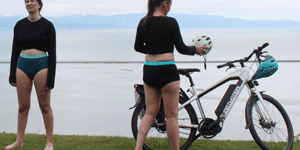


Components of a Bike Helmet.
How your Bike Helmets is constructed influences the performance of the Helmet. Learn about the components of a Bike Helmet and how that effect performance.
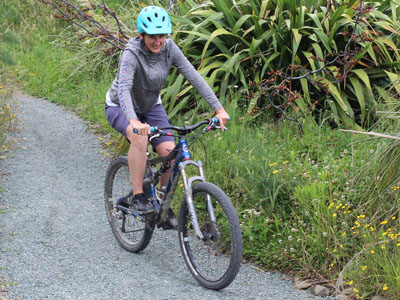
The function of a bike helmet
A Bike Helmet is designed to reduce impact by dispersing the impact energy. Though we are talking milliseconds the impact force is dispersed over a greater timeframe so the helmet is working to avoid that sudden stopping force on impact that may result in a brain injury. The success of a Bike Helmet is based on how the components of a bike helmet disperse the impact.
The 4 components of a helmet are; The Shell, The Inner ( Liner), MIPS ( if your helmet is equipped with it) and the Straps/ Buckles/ Pads and internal systems – everything that helps keep the helmet on and over your head in an impact.

Peak forces when not wearing a helmet.

Peak forces when wearing a helmet.
The 4 components of a Bike Helmet
 The Shell – the outer hard part of the helmet.
What is it made of? A type of plastic. The degree of hardness of the plastic can vary . The skate style helmets generally have a harder plastic than the more classical bike helmet. Alternatively they can be made of a composite (like fiberglass or lightweight carbon fiber.)
Function – The shell holds the helmet together and protects the foam liner. It takes the initial impact and allows your head to slide along the surface preventing the forces involved in abrupt stopping.
Key point: In the less expensive helmets the shell may be glued to the liner, some are taped around the edges, but not all. In the more expensive helmets the plastic shell is molded to the liner. The later helmet, is stronger though manufacturers take advantage of this increased strength by putting more and larger ventilation holes in the helmet. The harder shells make for a stronger shell but adds weight to the helmet.
 The Liner – the softer inner part of the helmet
What is it made of? Generally a foam called EPS (Expanded Polystyrene). This is where a lot of research and development is focused and we are seeing development of different foams. The foam can have other materials buried within it to help strengthen it.
Function – This is the key part of the helmet, where the energy of the crash is managed.
Key point: All foams immediately or eventually deteriorate under impact. This is why it is suggested you never buy a secondhand helmet and you replace your helmet following impact. Note: there are foams that do not deteriorate after impact and we are starting to see them in the market, but there is still progress to be made.
 MIPS ( Multi Impact Protection System) – If your helmet is equipped with MIPS it will sit between the liner (foam) and your pads.
What is it made of? Plastic.
Function – To support a reduction in rotation forces during an impact being transferred to your brain
Technology advances are improving in the world of helmets with the recent introduction of MIPS (Multi-directional Impact Protection System). MIPS gives better protection in sudden angled impacts. It copies or mimics the human brains protection layers – the skull and a layer of fluid underneath it (cerebral spinal fluid) by adding a low friction liner suspended from the interior foam casing by an elastomeric attachment system. What this means is that the MIPS allows independent rotation of the outer helmet. Redirecting impact energy means that less energy is being transferred onto your brain which means more protection.
Key points: Not on all helmets. Often has a yellow label of MIPS on the helmet and on the protective layer itself.
 Straps, buckles and clips. Pads, Occipital fastener and internal ring systems.
What is it made of? Nylon, polypropylene, foam and plastics.
Function – To allow adjustment to ensure the helmet fits snuggly to your head and stays there during an impact or multiple impacts (e.g. car and road)
Key points: Check that you can use and manipulate any fasteners easily, and they are strong and hold when pulled/tugged/twisted.
Your bike riding success is different to others… use our stories and support, get the right solutions.

Ride More Places
Bike Gear Stories
Women and families learning ...
Buying Guides

Solution Finder

Types of Riding Stories
Support and inspire other riders and families to ride
Share your riding outings, adventures and experiences on our quick and easy question and answer forms. Join us in helping others ride bikes. All entries receive a free shipping coupon and go into our seasonal prize draw.
goRide supporting women and families to SMILE when you ride