When we make the effort and take the time to go on a bike adventure we want it to be an enjoyable experience. To help plan your adventure read about our experience riding 267km of the 300km Alps to Ocean Trail, from Tekapo to Oamaru, in the South Island of NZ
The Alps to Ocean is part of the NZ Cycle trail network. It is a purpose built shared use track so you can ride this trail all year round.
Supporting you and your family to SMILE when you ride.
I chose to do this ride with the support of my Mum & Dad who have a self contained caravan, our accomodation. The Alps to Ocean is a track that stays relatively close to populated areas with each section starting and stopping in places that vehicles can access.
I rode the Alps to Ocean over 4 days and 3 nights in October 2016. This was mainly a ride for me, Annette, with my two children aged 11 and 8 joining me for child friendly sections of the ride. I decided to do the ride this way because of time restrictions – we only had 4 days to complete the trail. This means I will be riding multiple sections in the same day – distances which are too far for the children to enjoy. If you too are restricted by time but don’t want to ride large distances take the advice of the Kennett brothers…
“If you don’t have time to do the whole trail, cherry pick stages 2, 3 & 4 – they have the best scenery, the least traffic and lots of purpose built cycle path.”
The official NZ Cycleways website has a good break down of the track sections which helped me plan which sections to ride with the kids www.alps2ocean.com
The Alps to Ocean – is it doable for you?
The MacKenzie Country, where the majority of the Alps2Ocean ride is located, is sparsely populated. Tekapo has approximately 370 residents but enjoys a steady flow of tourists. It has a small supermarket, cafes, restaurants, petrol station and several different accommodation options. The biggest town along the trail is Twizel. Oamaru at the end of the ride is substantial compared to these villages, it has 21,000 people. This area is extremely popular with tourists and the two Highways you are riding by, or on, are major truck routes in and out of the central South Island.
Tekapo is becoming the preferred start point of the track (15km shorter). If you start at Mount Cook (a truely spectacular and memorable experience) you will need to take a helicopter ride over the Tasman River which is a wide, braided and glacial river. The helicopters only fly in good weather and a minimum of 6 people is required.
What skills & fitness will you need?
The Alps to Ocean trail has been designed to do over 6-8 fairly relaxed riding days. Most of the riding is flat and downhill so very achieveable with some consistant training before you go. The best preparation would be to get used to the feeling of riding day after day. Having said that there are some major hill climbs involved (900m climbing out of Ohau, over Otematata Saddle, up to the top of Benmore Dam and throughout the last section from Duntroon to Oamaru).
Because I have choosen to ride for only 4 days my training schedule has involved building up to several long distance rides (more than 50km) in one week. I have concentrated on distance rather than difficulty, choosing flat well graded trails to prepare myself.
Overall the surfaces are very cycling friendly, reasonably wide and smooth. There are some sections I would call off road single track that have a grade 3 rating. The trails are diverse and undulating with several hill climbs required.
How to be comfortable in the weather, on the bike, with your gear. You will need to understand the season you are planning to ride in. The MacKenzie country can be extremely hot in the summer and very cold in the winter months. This is a very popular Spring, Autumn trail for this reason. Only use & take clothing & gear you have used and will be comfortable with. See our stories on safety & gear.
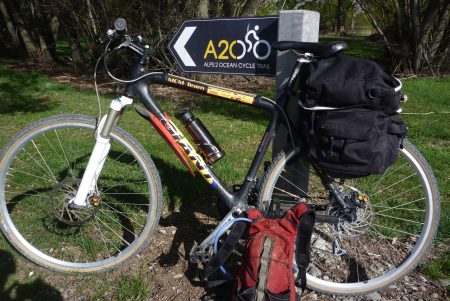
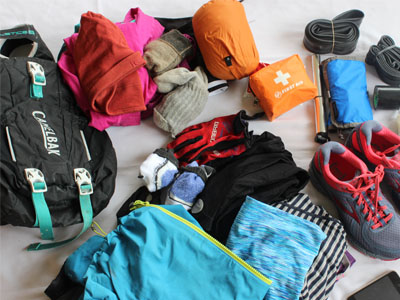
My bike and gear. Double panniers, a hydration pack & bottle cage with bottle gave me plenty of space & water for my supported day riding.
My Alps to Ocean Ride – Days 1-4
Day One: Tekapo to Lake Pukaki 43km (Kids rode from Tekapo to the bottom of the Power Station 30km)
We set off from the Tekapo start around 10.30am. This is opposite the town centre and clearly signposted with the red alternative route A2O signs, follow these until you reach the Tekapo Canal Road. You will need to cross State Highway 8 on this section, so take your time and be careful.
Biking – Tekapo to the shores of Lake Pukaki…43km…the first section Tekapo to State Hwy 8 along sealed & gravel flat roads next to the canal, 15km. We had lunch in the rest area after we crossed the Highway. After lunch we continued on along the canal road which again changed regularly from sealed to thick gravel and was slightly uphill in places, so was fairly slow going. Just before the Salmon Farm you are back on a public road and this is a popular fishing area. You will reach the top of Tekapo B Power Station. Jackets on then a speedy downhill. You will have biked another 15km to Hayman Road at the bottom of the hill. Traffic flow is moderate around this area so keep the kids close and alert to their surroundings. I carried on down Hayman Road towards the State Highway (left as you come down from the Dam) then onto a wide bike trail that ran along the shore of Lake Pukaki. Finishing at The Pines Camping area 13km from the Power Station
Facilities – There are toilets provided at each end of the canal road. Most of the canal road is closed to traffic but workers do have access so you may come across a truck or two. After you leave Tekapo there is no access to fresh water. There is no drinking water at The Pines Camping area.
Accommodation – We stayed overnight at The Pines which is a freedom camping area on the shores of Lake Pukaki very close to the information centre. It has a one night maximum stay restriction and a long drop toilet hiding up in the trees.
Carrying Gear & Support Vehicle – Using one set of panniers to carry the gear we required for our day. Each of us had a hydration bladder – my bladder was 3L, the kids each had 1.5L bladders. Vehicle access is restricted along these sections of the track so you will need to carry snacks, water, spare clothing/jackets, mobile phone, a bike tool kit and a compact bike specific first aid kit. Vehicles have access up Hayman Road off State Highway 8 just before the Information Centre. Hayman Road is sealed until you reach Tekapo B Power Station
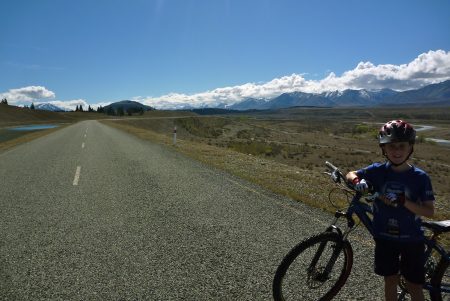
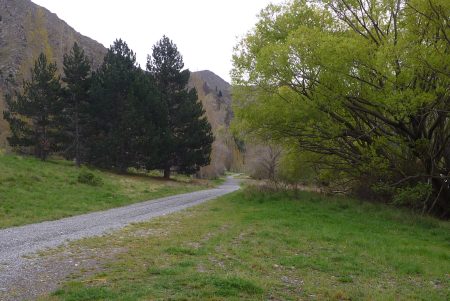
Canal Road after leaving Tekapo
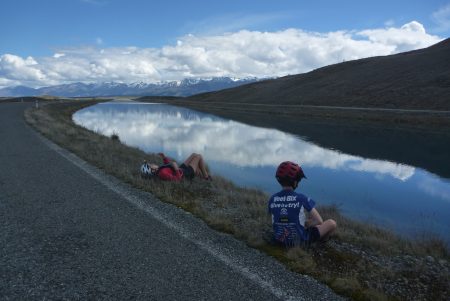
Resting next to the canal
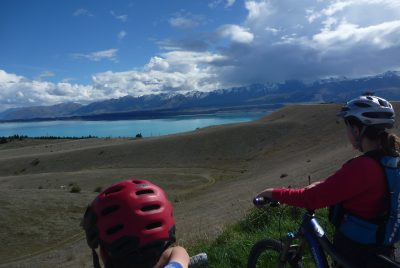
View over Power Station – Lake Pukaki
Southern Alps across canal
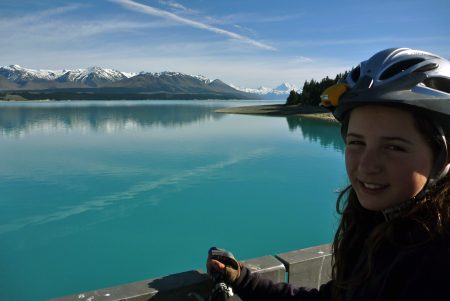
Mt Cook from shore of Lake Pukaki
Day Two: Lake Pukaki to Omarama 87km (11yr old rode from Pukaki to Twizel 11km)
Biking – Lake Pukaki to Twizel approximately 11km across Pukaki Flats Track which is as the name suggests a gentle & flat biking/walking track. At the information centre at the bottom of the lake you have to cross the Highway to find the Pukaki Flats Track. Twizel has a population of around 1200, and has good facilities. It is located on State Highway 8.
Twizel to Lake Ohau 38km. Again you have to cross the main highway to get into the centre of Twizel where you will find the Alps to Ocean signs that lead you to the right of town and out along Glen Lyon Road. After 18km biking along this sealed canal road you will reach the edge of Lake Ohau under the towering Ben Ohau Mountain. It is then 11km around an off road biking/walking track to Lake Ohau Road. A perfect spot for lunch. It is another 10km onto Ohau Lodge.
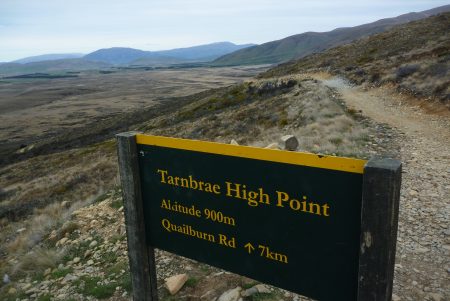
Lake Ohau to Omarama 38km. The next 18km of riding is along Tambrae Track which I would describe as a mountain biking single track and your first major climb – it is 900m up to the “High Point” and a very rapid descent then follows. Quailburn Road at the end of the track is gravel for approximately two thirds of its 20km length and unfortunately for me, it was new gravel, so difficult to ride. Quailburn Road finishes at State Highway 8 where you will join a great little biking track beside the road and river which takes you through Ahuriri Campground where we stopped to camp.
Total distance 87km of very diverse surfaces and riding
Facilities – Food, water, toilets all to be found in Twizel. First toilet after Twizel is at Ohau Weir along the shores of Lake Ohau then again along the road leading to Ohau Lodge. Apart from Ohau Lodge there are no other facilities at Ohau so don’t expect a coffee in a cafe, you’re in a remote area of NZ now. At the end of Trambrae Track a 2km detour will lead you to a historic woolshed picnic area & toilet at the very top of Quailburn Road.
Again no drinking water can be found along the track.
Accommodation – We stayed at Ahuriri DOC campsite 3km outside of Omarama which has a basic toilet. Omarama has a population of approximately 250 people. You will find a couple of cafes, a petrol station and limited accommodation.
Carrying Gear & Support Vehicle – Using one set of panniers to carry the gear I required for the day and a hydration pack with 3L bladder. Vehicle access is restricted along these sections of the track so you will need to carry snacks, water, spare clothing/jackets, mobile phone, a bike tool kit and a compact bike specific first aid kit. Vehicle has access at Twizel, Ohau & from Quailburn Road.
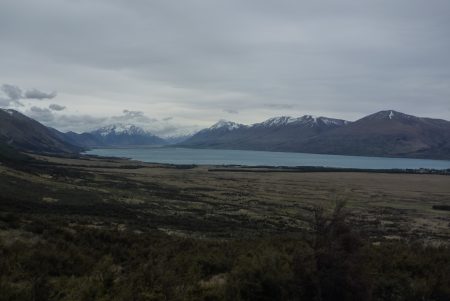
Lake Pukaki, Southern Alps
Ben Ohau Mountain
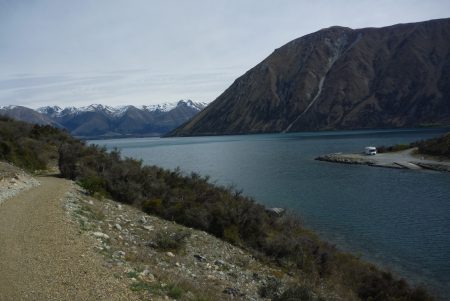
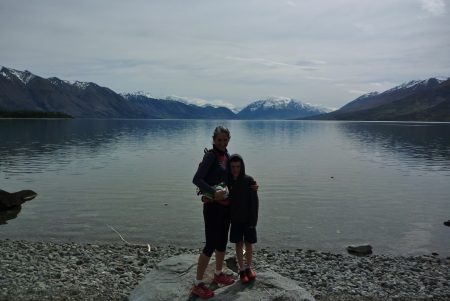
Lake Ohau
Tarnbrae Track
View back to Lake Ohau
Day Three: Omarama to Aveimore Dam 52km (Kids rode from Omarama to Sailors Cutting 13km)
Biking – Omarama to Otematata 27km, which includes 3km of riding from Ahuriri Campground into Omarama. The first section of this track from Omarama – 13km to Sailors Cutting – is a great off road smooth shingle track that offers easy, fun riding along the shores of Lake Benmore. At Sailors Cutting the track leads onto the Highway – 9km on State Highway 83 up and over Otematata Saddle – not recommended for children or those not accustomed to traffic. Trucks will be passing you on an open road – 100km speed limit…
Otematata to Aviemore Dam 28km. The track turns towards Benmore Dam just before Otematata township so if you want supplies or the toilet you will have to ride into Otematata. It has one small supermarket and a population of 200, again limited accommodation. From Otematata it is a simple 6km ride along a bike track to the towering Benmore Hydro Dam and YES you are going up and across it so take a deep breath and get in a low gear. The next 22km is along a sealed road next to Lake Aveimore – not a single car passed me but I imagine in summer that this road is busy with campers, boats and fishermen.
Total distance 52k
Facilities – Food, water & toilets all to be found in Omarama and Otematata
Accommodation – There are several different camping options along this section of track. Please be aware that this is a very popular holiday destination in summer so booking, if possible, would be essential.
Support Vehicle – The entire section is either next to the road or on a public road so vehicles have easy access to you.
NOTE this section of track is now off road (Feb 2020): I choose to miss the next section of road riding from Aviemore Dam to Kurow, 18km of HIGH TRAFFIC road riding. This was because of time restrictions and a southerly weather system that was forecast and generally because it is unpleasant to have trucks passing you at that speed with no room to get out of there way.
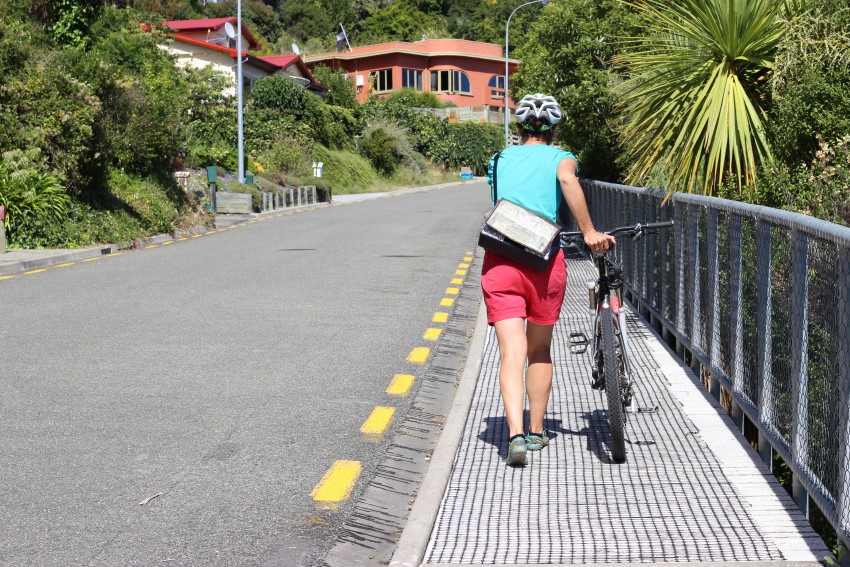
Track barriers along shores of Lake Benmore
Sailors Cutting
Road from Otematata into Benmore Dam
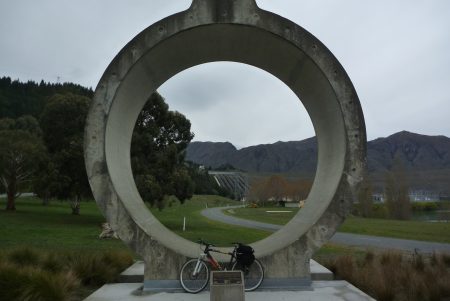
My bike under the cross section of dam pipe
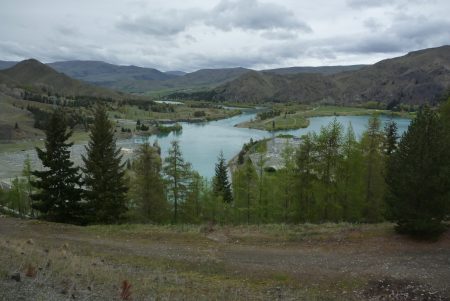
View from top of Benmore Dam
Day Four: Kurow to Oamaru 82km
Biking – Kurow to Duntroon 28km, followed by 54km to finish at the Pacific Ocean on the Wansbeck St Pier in Oamaru. Total distance 82km!
From Kurow the whole section of track is off road on flat yellow shingle or four wheel drive tracks. There are a couple of river crossings to attend to but this is generally a pleasant ride.
Duntroon to Oamaru is a diverse mix of sealed road, single bike track across working farms and back country gravel roads. Although you do eventually end up going down into Oamaru the bulk of this track is rolling countryside with constant climbs and descents. You will need a reasonable base of fitness to complete it comfortably. And watch out for the magpies – spring time means nesting – I got attacked by 4!! The public gardens & Victorian Precinct in Oamaru are an absolute pleasure to ride through. And as promised the trail finishes right next to the Ocean!
Facilities – Kurow (pop: 320) will provide food, water and toilets and limited accommodation if you choose to stay here. Duntroon (pop: 120) when I rode through on a Thursday in October at lunchtime no food places appeared to be open. Duntroon does have the Flying Pig Cafe but I would check whether it is open before depending on it for food. Rakis Railway Tunnel, 27km into this section has a table, toilet and drinking water from the tap.
Support Vehicle – Never far from road access with short off road sections throughout this ride
Enjoy the experience and have fun
New to Riding & Kid Friendly sections:
The Canal Roads make for easy, flat riding but could be a bit long depending on the age of your children, two 15km sections after Tekapo, one 12km section after Twizel
The off road section of track next to Lake Pukaki, 13km from Tekapo B Power Station to Lake Pukaki Visitor Centre
The Pukaki Flats Track from Lake Pukaki to Twizel, 11km
The Lake Ohau shore track from the end of Glen Lyon Road to Lake Ohau Road, 11km
Tarnbrae Track from Lake Ohau Lodge to Quailburn Road, 18km – your kids would enjoy this track only if they mountain bike regularly
Omarama to Sailors Cutting, 13km
Otematata to the top of Benmore Dam, 6km – the last 800m is steep! But well worth the effort
Benmore Dam to Aviemore Dam is on an undulating lake side road – watch traffic flow in summer, 22km
Kurow to Duntroon, 28km. Give yourself 3hrs…if this is too far do the beginning and finish just after 15km when the trail comes back next to the highway
Elephant Rocks to Conlans Road, 7km – yours kids would enjoy this track if they mountain bike regularly
Pig Island Road just after Winsor to Oamaru, 18km. If this is too far there are a number of places along this section to join or leave the trail at.
Kurow Winery
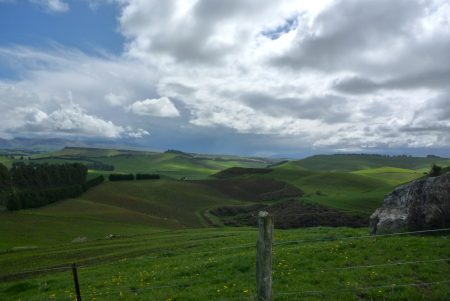
Rolling Oamaru countryside.
Public gardens in Oamaru.
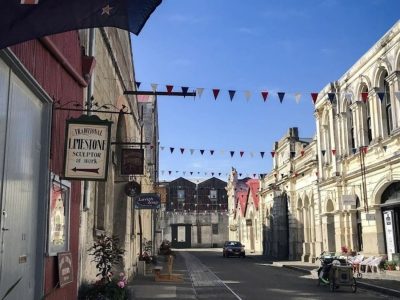
Limstone buildings & Steampunk vibe of Oamaru Victorian Precinct.
Your bike riding success is different to others… use our stories and support, get the right solutions.
Read stories about NZ trails, tracks & parks. Find out what other families & riders are doing. Be inspired! Is this ride an option for you or your family?
A collection of stories that will help you learn about bike gear. goRide supporting you to get the right bike gear solution for the type of riding you do or want to do.
Stories in Types of Riding support you to learn about riding a bike in different environments. So you can successfully choose to ride more place, more often.
Support and inspire other riders and families to ride
Share your riding outings, adventures and experiences on our quick and easy question and answer forms. Join us in helping others ride bikes. All entries receive a free shipping coupon and go into our seasonal prize draw.
Enjoy our story of the John whanau (Mum, Dad, 10 year old boy and a 8 year old girl) riding the West Coast Wilderness Trail over 5 dayson the Westcoast of the South Island New Zealand
Supporting you and your family to SMILE when you ride.
When we make the effort and take the time to go on a biking adventure with the family we want it to be an enjoyable experience. To help plan your adventure read about the John whanau experience riding the 139km West Coast Wilderness Trail in April 2016, riding from Greymouth to Ross.
Where is it?
The West Coast Wilderness Trail starts across the road from the i site at Greymouth on the West Coast of the south Island New Zealand
The ride and is it doable for you?
The West Coast Wilderness Trail is 139km in length. Greymouth to Ross. At the time of riding, the section from Hokitika to Ross was less developed and if this would suit your family better you could consider the 103km from Greymouth to Hokitika. A good website to help with the planning of your trip is the westcoastwildernesstrail.
We have chosen to do it over a 5 day journey to make it achievable for our young family. Because of where there is availability of accommodation your child will need to be capable of riding around 30-40km in a day.
DAY ONE – Greymounth i -Site to Top 10 Holiday Park Greymouth = 7km – is it doable?
This was a travel day for us driving from Nelson to Greymouth. We stopped at the Greymouth i site (which is opposite the start of the trail). They chose to bike the first 7km of the trail as their accommodation was located 7km along the trail. Ticking off the first 7km on their traveling day allowed the following day to be a little shorter to attempt to save the legs and motivation for the gentle uphill ride of Day Three.
Biking – The start of the Westcoast Wilderness Trail outside the i site to their accommodation the Greymouth Seaside Top 10 holiday Park, 7km.
Car Shuttle – An adult rode back along the 7km seaside trail to collect the car (while the kids enjoyed the playground and exploring the holiday park) and drove it to the Holiday Park. The car was left in the complementary storage area while they cycled the trail.
Accommodation – stayed overnight at the Greymouth Seaside Top 10 Holiday Park. With the trail on their doorstep it allows you to set off in good time for biking.
Highlights – It was great to get the perspective of Greymouth from the top of the stop bank, see the Greymouth bar, and the activity of the river.
The Greymouth Holiday Park offers storage for your car and transport/shuttle options for the trail.
DAY TWO – Greymounth i -Site to Kumara 29km – is it doable?
Biking – Greymouth to Kumara 29km. The trail is signposted every 1 km
Accommodation – They stayed in a cottage at Kumara. Check out www.kumarawestcoast.org. A fantastic website showcasing all Kumara has to offer. Voluntarily maintained by a local – only on the West Coast.
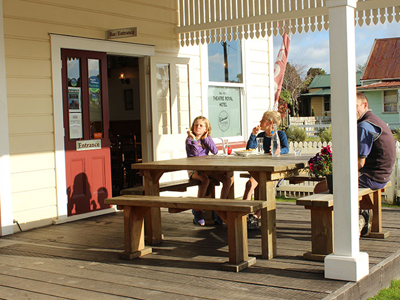
Highlights/Tips – It is a coastal ride until you ride over the cycle bridge that is clipped onto the Taramakau bridge – the only remaining combined road and rail bridge left in NZ. After the bridge you turn inland and ride through some scenic forest trails to reach Kumara. The cycle trail is bringing the history of the gold mining town alive. We enjoyed the historic Kumara hotel and across the road you find boards explaining the history of the region.
We were self sufficient with gear using panniers and a bike trailer carrying the gear we required Services are available for transportation of gear to each of your nightly destinations.
DAY THREE – Kumura – Cowboy Paradise 37km – is it doable?
Biking – This is the hardest day as you are going uphill and there are a few steep parts (only a few, though it did require our 8 year old to get off and push her bike a couple of times). The trail is signposted every 1 km.
Highlights/Tips – There is a worthwhile side trip not far out of Kumara to LondonDerry, this huge rock, the guide books claim potentially the largest in the world! Today you are heading up towards the mountains. On your way you enjoy resevoirs, following the water races, single track through the forest – it was all just magical.
We were self sufficient with gear using panniers and a bike trailer carrying the gear we required Services are available for transportation of gear to each of your nightly destinations.
DAY FOUR – Cowboy Paradise – Hokitika 37km – is it doable?
Biking – You cover this distance a little quicker as it has a good downhill section from Cowboy Paradise. The trail is signposted every 1 km. The kids loved the well graded single trail through the forest along the water race. Lots of magical moments whizzing through the trees.
Accommodation – Stayed in Hokitika..there are multiple accommodation options in Hokitika.
Highlights/Tips – This ride is primarily downhill and a great reward for some tired legs following the longer uphill day the day before – this day on the bike seemed to fly by. The switchbacks down to Arahua River from Cowboy Paradise. The beautiful Lake Kaniere (there is a bit of hill to get over before Lake Kaniere which Hollie was not too impressed by following day three). The single trails through the Kaniere water race – again just magical. There is a little bit of road riding on the last stretch into Hokitika. If you haven’t been to Hokitika it is a great little Westcoast coastal town.
DAY FIVE – Hokitika to Ross 36km – is it doable?
Biking – When we rode the trail in April 2016 and at this point in time the trail was less developed than the previous sections . The signposting every 1 km had not been completed for this section of the trail.
Car Transfer – Our car was transferred to Ross and ready for us when we arrived.
Highlights/Tips – Now the minds and body were starting to tire. Everyone kept going knowing there were promises of ice cream and a return to Hokitika on the way home to enjoy Fat Pippa pizza. This ride did involve some road riding along State Highway 6 which felt a little challenging after being on back roads and trails the days previous. There was a large grassy shoulder so the kids were instructed to go onto the shoulder any time a car passed.
What skills will you need to do this ride? This track is a well graded grade 2 trail. You need to be comfortable riding on gravel and doing some relatively easy single track.
What level of fitness will you need to do this ride? You can complete the ride over as many days as you like and therefore determine how many kilometres you ride in a day. However due to where there is accommodation located it is likely riders will need to be comfortable riding 30-40km in a day. And they will need to ride this distance on consecutive days
How could the weather effect the success of your journey? Expect the weather to play a part in your biking journey when you ride the West Coast Wilderness Trail. You are on the West Coast of New Zealand and thus likely to experience varied conditions You need to be prepared for all types of weather.
Riding with Kids Attached or Towed?
Be safe and comfortable when riding the West Coast Wilderness Trail
Enjoy our mulltiday bikepath riding pages that introduce gear and stories to get you ready to ride
Throughout this trail there is reasonable support with riding through towns such as Greymouth and Hokitika however there are times of remoteness especially from Kumara through to Hokitika so being prepared is important.Use our stories for multiday biking to help support you to be prepared to ride the West Coast Wilderness Trail
Carrier and panniers – carrying sleeping bags and clothes
Backpack and hydration reservoir (Camelbak low rider 10L)
Front frame bag – Camera and Valuables
Seat bag – tools and spare tubes
Gear set up – Nic (Male adult)
Small Backpack
Gear Trailer – Carrying food and clothes
Gear set up – Kids
Hydration backpack – carrying water a warm top and something special ( small) of their choice.
Enjoy the experience and have fun
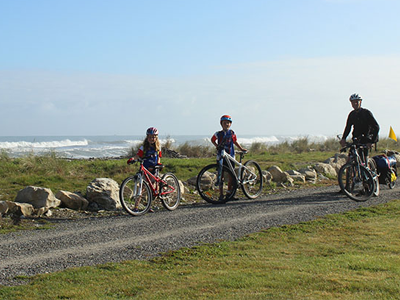
There were many highlights enjoyed along the way.
The kids enjoyed the motivation that having a signpost every kilometre gave them. – find ways to celebrate your distance covered.
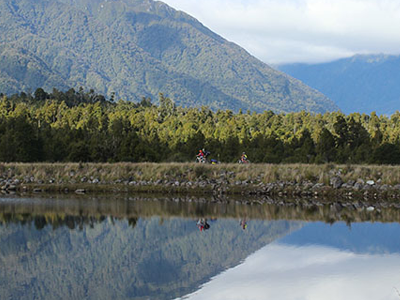
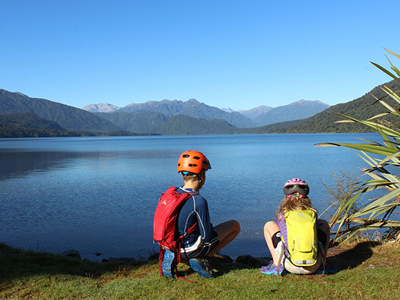
There is a lot of diversity and history along the ride – coastal riding, alpine outlook with snow capped mountains, rivers, beautiful reservoirs, lakes and some west coast quirkiness like staying at Cowboy Paradise.
Having the The West Coast Wilderness riders handbook enabled the trail and environment they were riding through to come alive. The trail notes give you an understanding of the history and the stories of the land (the whenua) and the people (tangata whenua).
Sunset from Moonlight Tops.
Hollie on the top… a good view of the track.
End of the Paparoa… Punakaiki.
Your bike riding success is different to others… use our stories and support, get the right solutions.
Read stories about NZ trails, tracks & parks. Find out what other families & riders are doing. Be inspired! Is this ride an option for you or your family?
A collection of stories that will help you learn about bike gear. goRide supporting you to get the right bike gear solution for the type of riding you do or want to do.
Stories in Types of Riding support you to learn about riding a bike in different environments. So you can successfully choose to ride more place, more often.
Support and inspire other riders and families to ride
Share your riding outings, adventures and experiences on our quick and easy question and answer forms. Join us in helping others ride bikes. All entries receive a free shipping coupon and go into our seasonal prize draw.
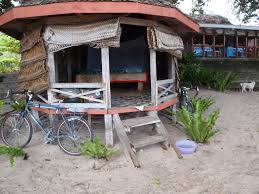
New Zealand kids love to ride bikes. It’s almost a part of their DNA. We can all remember learning to ride and the fun that came with that journey. In this story you will meet a young lady who learnt to ride quite a while ago. She is learning new things about riding now and discovering the different kinds of places you can goRide – Riding in Savaii, Samoa with her family. She will continue to learn as her body grows and skills grow, it’s all about ages and stages…
Like all our stories we hope to connect you to real kids and provide inspiration and motivation for you to goRide more places, more often with your kids. Enjoy your reading.
Riding in Savaii, Samoa for the NZ Falcon
This story gives us a couple of things
Inspiration to take the family on a winter holiday with a riding twist
Inspiration to do something for the less fortunate people or species on our planet
Can you tell us a little bit about yourself, like how old you are, how long you have been riding a bike, and where you like to go riding?
My name is Yasmina and I am 11yrs old (10 years when in Savaii, Samoa). I have been riding a bike since I was 2. My most favourite place to go riding is the Old Ghost Road
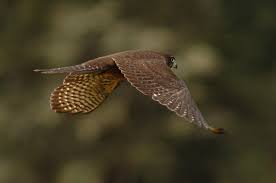
When did you come up with the idea of raising money while cycling and why the NZ falcon?
Because the Falcon is endangered and its my favourite animal. I decided 2 months before going to Samoa
How much money did you raise and what organization did you give it to?
$1000 for the Marlborough Falcon Trust
How many days was your trip and how far did you ride each day?
7 days riding average 30km per day
Did you do a lot of training before you went to Samoa?
Not really
What was your favourite part of the cycling trip?
The hills
What was the worst part of the cycling trip?
When we had to have a rest day
Can you tell us about the heat and how you managed riding in it?
It was very very hot, I felt like I wanted to ride my bike into a swimming pool. If I went faster than 10km per hour I kept cooler
What advice would you give to other children thinking about doing something similar?
Be prepared for the heat and wear suitable clothing
Is there anything else you would like to tell us about your trip or raising money?
I enjoyed it very much, I will try to do it again with my family when I am 20 because I also did it when I was a baby.
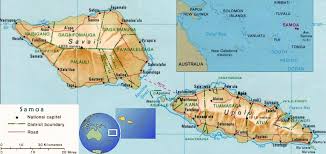
Some details to help you decide whether riding in Savaii is for you and your family
[one-half-first]
There are direct flights from Auckland to Samoa (Apia – the capital on Upolu Island)
Savaii’s rainy season is from December to February
It’s dry season is from July to September – remember this is a tropical location so it will rain every 2/3 days
This ride is approximately 200km, with towns and resorts spaced well for easy planning – every 30km or so
Savaii has an excellent sealed road surface which is ideal for cycle touring
goRide is a shared journey, so we would like you to assist in guiding it along. Contact goRide. Your thoughts, comments or feedback are welcome. Thank you for being a part of the goRide way.
The goRide women profiles tell stories about everyday women who ride bikes. These stories will connect you to real women and perhaps spark an idea about what you could achieve with your riding or remind you what you have done. In this story enjoy biking tips for older women. We are all on a journey, regardless of whether you are beginning or an experienced rider, so be open and curious and see what happens. Lets begin to build a stronger you and a stronger female riding community. Enjoy reading Sandra’s profile…
RIDING WORD – Enjoyment
When did you learn to ride and why do you still ride?
I first learnt to ride when I was 13 years old but I didn’t really bike anywhere. Then at age 60 I started again (7yrs ago). So it was like learning to ride all over again. The gearing was the hardest thing. We never had gears when I first rode a bike. It took me a while to learn what gears to use when – to be able to look at a hill and just know what gear you need to be in to get up it. I did a lot of walking up hills to begin with.
My husband brought me my bike so I started and now I love it. I was doing a lot of walking and wasn’t that interested but now I try to bike every day weather permitting.
What kind of biking do you do…
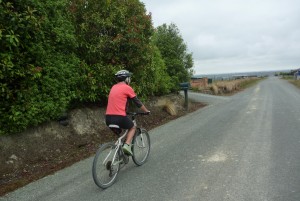
Everyday for fitness and to train for the bigger rides that we do on the New Zealand Cycle trails. Most of the riding is on quiet back country roads as I live on the outskirts of Geraldine. I ride a simple Avanti bike which is fine for me. I just needed the basics to get started and not make it too complicated.
Your Favourite Piece of Bike Equipment.
My new thermal jacket which is both wind and water resistant and just lovely to wear in the cold.
Do you have a biking tip or piece of advice that you would like to share?
Take it slowly to start with and stay off the main roads. Don’t push yourself or expect too much. The important thing is just to start even if it’s only to the end of the road and back. Doing small bits like this means you can get back on the bike the next day and the next and look forward to it without being sore or feeling overwhelmed.
What, if any, are your frustrations with riding? Personally and/or generally.
It’s important that both motorists and cyclists are considerate. It amazes me that some people who drive cars don’t know what to do around cyclists. If I ever feel unsafe I just get off and walk for a while or wait for a bit. Cyclists riding in groups need to be aware of what their actions can cause. It only takes two riders ignoring their environment (riding next to each other & chatting) to create a dangerous situation.
What is your favourite ride now?
A cycling track through the sand dunes at Opotoki. It was just really well made and such a fun place to cycle through.
What is your favourite ride from the past?
The Central Otago Rail Trail because it is such a safe, off road track through my favourite part of New Zealand.
Do you have a riding goal at the moment? (think equipment, skills/technique, rides)
Future: To try and finish the Alps to Ocean ride. They have improved the end of the ride by taking more of it off road. We stopped the first time because I just didn’t enjoy riding on a main highway. I don’t feel safe when cars are passing me at that speed no matter how aware of me they are.
I just want to keep riding for as long as I physically can.
Anything else you would like to share:
A gel cover for your seat helps for the first few months then you can take it off once you have become used to riding.
goRide is a shared journey, so we would like you to assist in guiding it along the way. Contact goRide. Your thoughts, comments or feedback are welcome. Thank you for being a part of the goRide way.
First time round it was easy. There were wide open spaces everywhere and cars went slowly. You know it would be good for you – getting back into bike riding or perhaps you’re considering learning to ride for the first time. The fresh air and sunshine, the exercise and companionship are a recipe for good health and staying young.
So whats holding you back?
I’m too old for this
I’m too unfit
I have no time
My joints will ache too much
What if I get a puncture – how will I fix it?
I’ll feel silly because everyone else will be better than me
I don’t know where to start
My husband was going to buy me a bike but now he’s gone
Large people don’t ride bikes
What if I fall off?
I don’t know where the trails are or which ones to go on
Do any of these excuses sound familiar?Well it’s time to stop.
Ifhaving fun, being safe, feeling comfortable and a doable ridesounds like you then it’s time to get back into bike riding (check out our story “How to have a ‘Great Day’ on the Bike” it has some really useful information). As you begin to ride again, or for the first time, try to think of your riding as a way of life, just something that you do, rather than a sport or exercise program. Here are some more tips and suggestions to make this new experience as smooth and easy as possible.
[one-half-first]
Your pace
[/one-half-first]
[one-half]
as slow as YOU need to be. Small distances are fine (to the end of your street). Think about start and stop points and combining a ride with a bus/train trip or parking the car. Getting off on a hill is OK if that’s what you need to do. Be patient, make it fun not another task you have to achieve. Think small steps leading to significant gains.
It’s not only pace but place. Think about the types of terrain you would enjoy riding on and the sights you would enjoy seeing. If traffic scares you only ride on cycletrails or shared patheways to begin with. Begin slowly with easily obtained goals, let your body adjust and become used to the bike. Nobody is watching you and judging, we are all different and we all have our own challenges to overcome.
[/one-half]
[one-half-first]
With friends
one of the greatest pleasures you can find from riding is how easy it is to share with friends and family so let them know what you are planning to do and get them involved. You will be amazed at the time that has flown by while you’re chatting – safely – with a friend. It’s totally fine if all you’re doing to being with is nodding in agreement while focusing on breathing – don’t be scared to stop for a rest, you’re with friends.
organised groups – look for community notices, bike club events or start a group of your own. If you get involved with a diverse group of people who enjoy riding there will always be someone planning something or wanting to go try something new. You can get inspired by this and then inspire others with what you would like from your riding.
[/one-half-first]
[one-half]
[/one-half]
[full_width]
Be committed
consistency is important. Schedule rides and make them a priority in your day and week. Shorter rides more often is better for you than one long ride in the weekend. Look for opportunities where you could ride your bike rather than take the car.
friends and family can help. It’s always harder to cancel a ride when you are letting someone else down.
don’t let the weather scare you off completely. Make plans around it or get good protective gear – layers for warmth, a jacket for the wind & rain, sunglasses/sunscreen, gloves & socks for the extremities…[/full_width]
[one-half-first]
Get some help
Good body position on the bike is important.
[/one-half-first]
[one-half]
try a community centre learn to ride program or community/bike shop basic maintenance course. Extend your confidence with a coaching session e.g. learn to ride off road with Wheel Women – for Nelson/Tasman ladies. Your local Sport Trust could be running learn to ride programs or Women’s Only rides. Get in contact with them and find out what’s being offered in your region. They will know who is doing what.
learn a bit about your bike and the tools that go with it. It can be simple, start here, our resources are designed for beginners just like you.
think about other exercise that could support your riding. Building endurance, strength, flexibility and balance work will all improve the experience you have on your bike. Good examples are yoga and weight training. Read more about your body position on a bike with our Chi Riding Series.
[/one-half]
[full_width]
Set a goal
rethink your horizons, focus on health, well being and learning a new skill or using new equipment/tools. Riding should become a part of who you are leading to you naturally choosing to ride more places, more often.
think about where in your community, region, country or world you would like to explore by bike. Get some ideas from reading our Women’s Profiles or ‘Great Day’ on the bike stories.
enter a women’s only event – there’s nothing like a deadline to scare you into riding…e.g. Spring Challenge or a women’s triathlon.
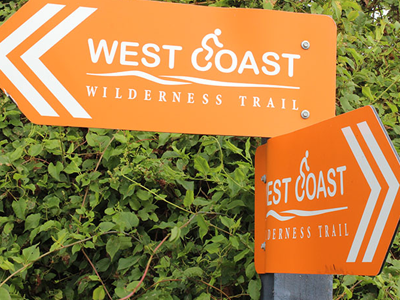
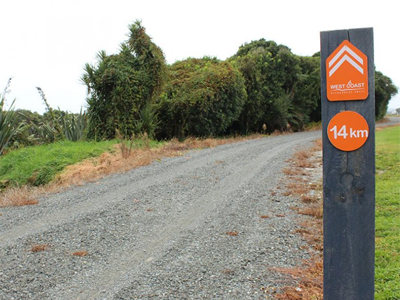
West Coast Wilderness Trail
“It’s not what YOU ride but that YOU ride
It’s not how fast YOU go, it’s about enjoying the ride
It’s not when YOU started riding, but continuing to ride each day”
goRide is a shared journey, so we would like you to assist in guiding it along the way. Contact goRide. Your thoughts, comments or feedback are welcome. Thank you for being a part of the goRide way.[/themeone_section]
When we make the effort and take the time to go for a ride with kids, we want it to be an enjoyable experience. To have a ‘great day’ on the bike with kids there are simple things to think about, plan and do.
In this story we are riding in the – Craters of the Moon Mountain Bike Park (Taupo) on some of the beginner to intermediate tracks with Rhea 9yrs old – mountain bikes occasionally, Isaac 6yrs old – mountain bikes occasionally.
Supporting you and your family to SMILE when you ride.
Craters Mountain Bike Park is a purpose-built mountain bike park located only a short distance from Taupo town, with trails ranging from children’s entry level to technical cross country and downhill trails. As the mountain bike park is located 10kms out of Taupo most people drive to the carpark, 500m off Wairakei Drive up Karapiti Road, and start their riding from there. But there are bike tracks to ride out to it.
Craters Mountain Bike Park has around 50km of bike trails to suit all abilities. There are plenty of options to choose from, allowing you to escape for just an hour or two or have a full day on the trails.
Before riding in the mountain bike park you must be a Bike Taupo member, annual and visitor passes are available from Taupo cycling shops (Top Gear Cycles, Avantiplus Taupo), The Hub Kitchen Cafe, or online from Bike Taupo (see previous link). If you need to hire bikes see Avantiplus Taupo, Tread Routes, Top Gear Cycles or Pack & Pedal.
There is a map board at the carpark and but it’s always a good idea to carry a map the first few time you ride in a new environment. Forests can be very confusing to ride through and if there are lots of junctions you will soon get lost. Maps are available for $5 at local cycle shops, The Hub Kitchen Cafe or online. The Bike Skills section is not marked on the maps. You will find it on Track 32, Scraggs/Track 33 Scraggs Routine. Check over the board in the carpark as there are some route suggestions you may want to consider.
Here is the link to Bike Taupo where you will find the map and info outlining Craters of the Moon, Wairakei Forest
The ride – is it doable for you?
This park has something for everyone. It is a matter of working out what will work best for your family. For first time riders the layout of a bike park can be confusing so find a map and study it before you go.
Biking Distance? The length of this ride is entirely at your discretion you have approximately 50km of grade 2 to grade 5 single track to choose from but if your kids don’t mountain bike as a sport they will be restricted to the easy to moderate tracks.
Biking Surface/Biking Skills required/Level of biking fitness: The beginner tracks are short and loop you back close to the carpark so time and distance shouldn’t be an issue. Basic mountain biking skills will be needed but again the easiest tracks are well designed for beginners just be aware of other track users. The biking surface in mountain bike parks is varied but mainly compact dirt with a few gravel or pine needle sections and some tree roots to contend with. All trails run in and out of exotic pine and eucalyptus plantations. The volcanic pumice soils allow for year round riding with free draining qualities that are not found anywhere else in New Zealand.
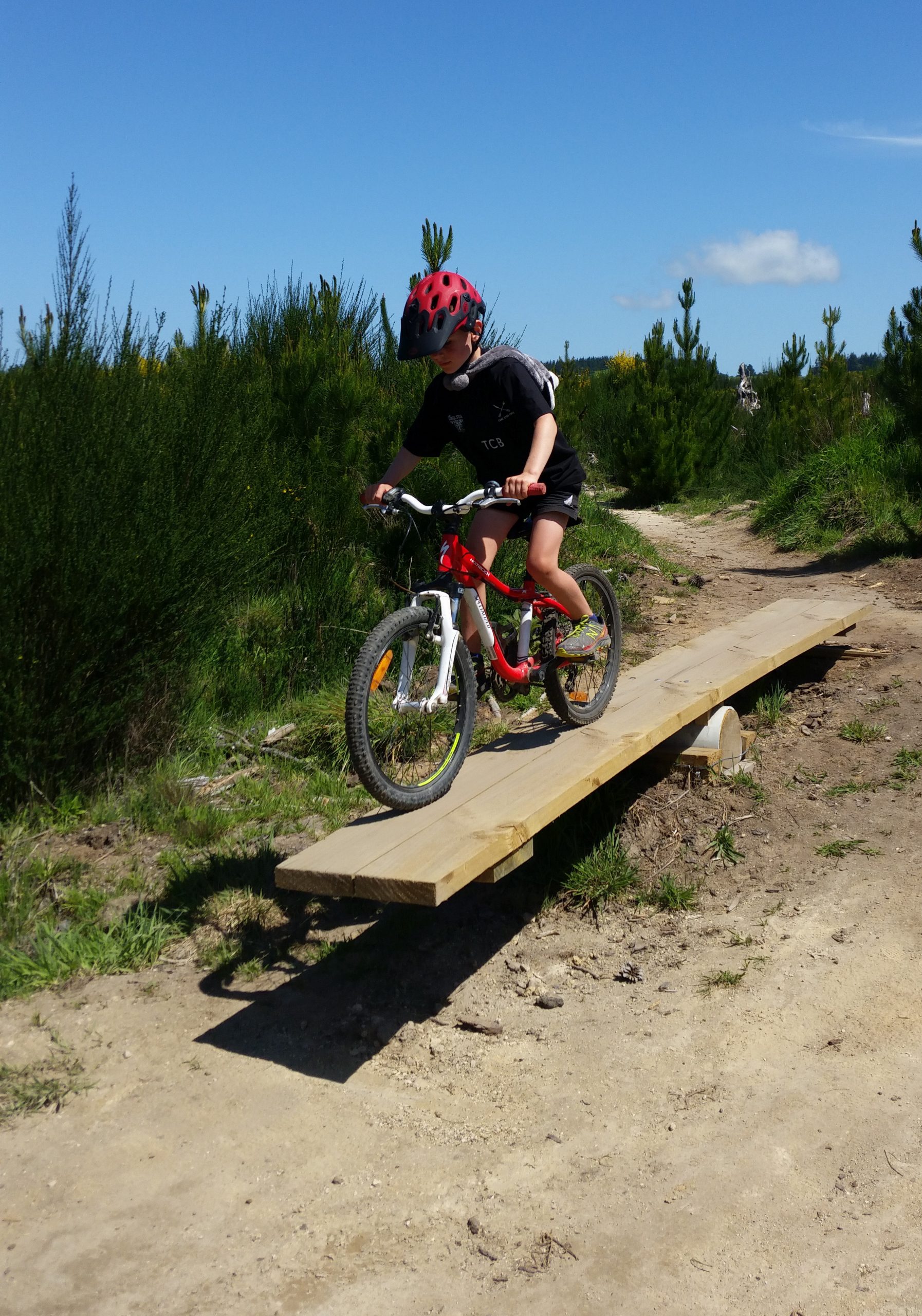
Taupo’s mountain bike park has a bike skills section which includes see saws, raised wooden structures, drop offs which is s fun way to learn.
Can you ride with Kids Attached? This is a ride that you can enjoy with kids being towed or attached to your bike.
Some additional support may help get the kids riding in Caters of the Moon Mountain Bike Park.
For independent riders : The Tow Whee Tow Rope may help assist getting them up a hill, or keeping up with older siblings.
Attached to your bike: The Shotgun offers you the ability to enjoy the mountain biking park with your younger kids. You will need to ride to your ability making sure you are keeping them safe.
Example of the sign posts telling you about the track you are riding.
Some Trails that our group enjoyed.
For younger and/or beginner riders:
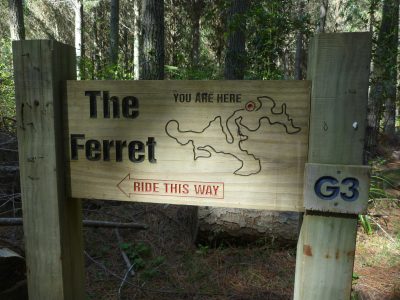
We rode in the easier, forested section next to the carpark for an hour exploring the Green/Blue Tracks like Tourist Trap, Piker, Ferret and Return to Sender.
We then had lunch and rode in the area across the road, again for approximately an hour. Climbing Tank Down and descending on Walters Wiggles.
Once we had returned to the carpark and had a chat with the chairman of Bike Taupo – a chance encounter as he collected donations from the box – we spent a further 30 mins on the bike skills track.
For confident beginners to intermediate riders:
Bike Skills Track (Scraggs – Track 32/33) behind carpark. The kids had a blast on this well thought out track (so did Dad). They rode over and off things that initially looked scary to them – what a great confidence boost. These types of bike skill obstacles create great learning environments – testing balance and decision making skills. The whole idea is to play around and get used to the feel of your bike and body moving together. Also to try things several times and watch what other people do.
Fun flowing, flat riding on Tourist Trap
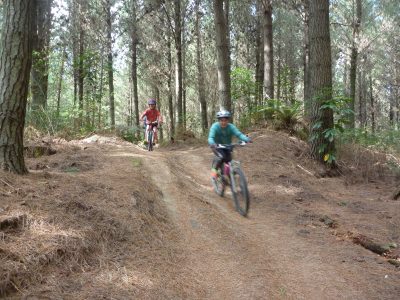
Kids enjoying riding trails to match their level
Interesting skill sections and obstacles on Scaggs
Be safe and comfortable when riding in Craters of the Moon Mountain Bike Park.
How far you are venturing away from your base will determine the amount of gear you need to carry. As the riding network is quite extensive it is good to be prepared so you can manage any situation. Whether that be an injury, energy or water requirements. Also the option of layers to ensure everyone is riding at a comfortable temperature.
The skills track (Scaggs) was a highlight for the kids, spending time completely sections and watching each other
Huka Falls…across Wairakei Drive… can be ridden to from the mountain bike park via an underpass…on Track 18, Tunnel Trac
Let the kids lead the way. Let them find the tracks and work out what signs and names they should look for along the way. The signs in this mountain bike park are well done so are perfect for those new to map reading.
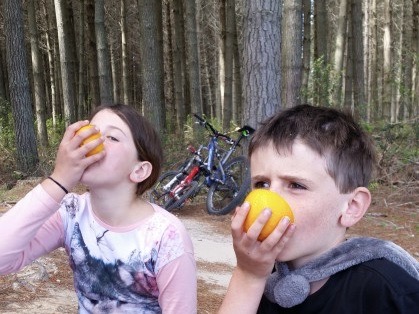
A picnic lunch under the cover of the trees. We found a spot off to the side of a track and munched on our lunch. The kids discovered what great water glasses oranges make…
Your bike riding success is different to others… use our stories and support, get the right solutions.
Read stories about NZ trails, tracks & parks. Find out what other families & riders are doing. Be inspired! Is this ride an option for you or your family?
A collection of stories that will help you learn about bike gear. goRide supporting you to get the right bike gear solution for the type of riding you do or want to do.
Stories in Types of Riding support you to learn about riding a bike in different environments. So you can successfully choose to ride more place, more often.
Support and inspire other riders and families to ride
Share your riding outings, adventures and experiences on our quick and easy question and answer forms. Join us in helping others ride bikes. All entries receive a free shipping coupon and go into our seasonal prize draw.

















 New Zealand kids love to ride bikes. It’s almost a part of their DNA. We can all remember learning to ride and the fun that came with that journey. In this story you will meet a young lady who learnt to ride quite a while ago. She is learning new things about riding now and discovering the different kinds of places you can goRide – Riding in Savaii, Samoa with her family. She will continue to learn as her body grows and skills grow, it’s all about ages and stages…
 Riding in Savaii, Samoa for the NZ Falcon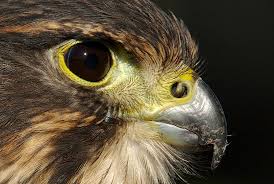
 When did you come up with the idea of raising money while cycling and why the NZ falcon?
 [/one-half]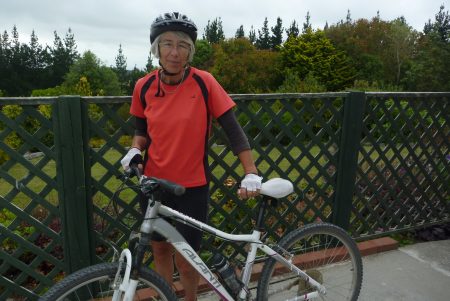
 What kind of biking do you do…
 A cycling track through the sand dunes at
 First time round it was easy. There were wide open spaces everywhere and cars went slowly. You know it would be good for you – getting back into bike riding or perhaps you’re considering learning to ride for the first time. The fresh air and sunshine, the exercise and companionship are a recipe for good health and staying young.